Land clearing site handover: what the next contractor needs
A clear site is not automatically ready for the next trade. Use this practical handover checklist for approvals, services, access, stumps and finish.
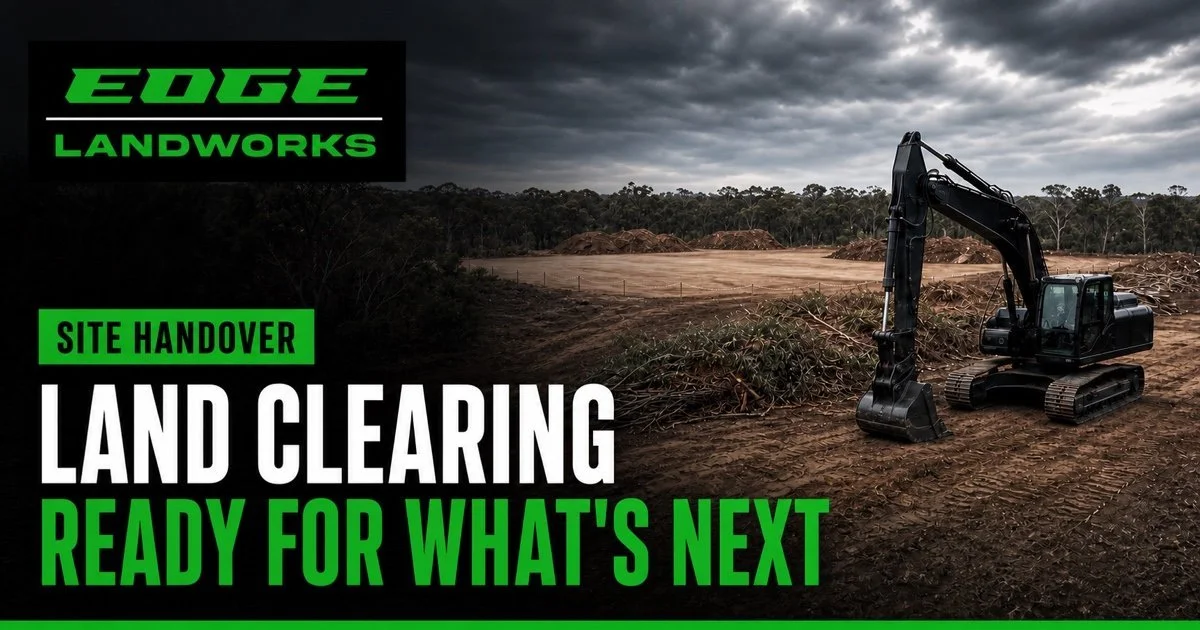
Land clearing is often the first stage of a bigger job. A builder, surveyor, civil contractor, fencing crew, landscaper or property owner may need to work on the site next.
That means “clear the block” is not a complete handover brief.
The required finish depends on what comes next. Clearing for access is different from preparing a building area. Leaving mulch can suit one rural property but create extra work where the next contractor needs exposed ground and precise set-out.
This guide explains what to agree before machine work starts and what to check before the clearing contractor leaves.
This guide provides practical general information, not legal, environmental, surveying, engineering or work health and safety advice. The approvals, duties and technical checks required depend on the property, work scope and next use of the site.
Start with the next use of the site
Tell the clearing contractor what the site needs to support after handover.
Useful questions include:
- Is the work opening access or preparing a defined project area?
- Which vegetation must stay?
- Are stumps being ground, removed or left outside the next work zone?
- Does the next contractor need exposed ground, a rough trim or work to supplied levels?
- Can mulch remain, and if so, where?
- Where can material be stockpiled?
- What machinery and deliveries need to enter next?
This information helps separate land clearing from earthworks, surveying, engineering and construction certification. It also gives both parties a clear result to price and inspect.
1. Confirm the approved clearing area
The work area should be identifiable on the ground, not just discussed over the phone.
Use the approved plan, marked boundaries or a suitable set-out method for the project. Identify retained trees, vegetation buffers, no-go zones, waterways, fences and neighbouring property before the machine enters.
WA Government guidance says a clearing permit is required for native vegetation in Western Australia unless an exemption applies or DWER has determined through the referral process that a permit is not required.[1]
A clearing permit, exemption or referral decision does not establish authority under every other law. Local planning or building requirements, Aboriginal heritage, Commonwealth environmental requirements and other project-specific conditions may still apply.[1][4] WA Government building guidance directs applicants to the relevant local government for its requirements and local laws.[7]
A local firebreak notice, development approval or construction plan should not be treated as automatic permission to clear anything outside its actual scope. The landholder or project proponent needs to identify and obtain the approvals that apply and give the contractor clear limits.
WA Government guidance also states that landowners must not knowingly damage an Aboriginal cultural heritage site.[4] Where a known or potential site may be affected, obtain appropriate heritage information and advice before ground disturbance. A database or map search alone does not prove that no heritage is present.
At handover, check that the completed area matches those limits and record any approved change made during the job.
2. Separate clearing from survey and level requirements
A visually clear site is not the same as a surveyed or certified building platform.
If the next stage relies on boundaries, finished levels, slopes, drainage falls or structural performance, provide the relevant survey, engineering or construction specification before earthworks begin. Use the appropriate qualified professional for set-out, testing and certification where required.
The clearing scope should state whether Edge Landworks is:
- removing or mulching vegetation only
- grinding or extracting nominated stumps
- stripping or setting aside topsoil
- shaping rough access
- completing separate earthworks and site preparation
- working to supplied survey pegs, plans or levels
Do not describe a site as “building-ready” unless the agreed scope and required checks support that statement.
3. Identify underground and overhead services
Services can cross rural, residential and commercial properties in places that are not obvious from the surface.
WorkSafe WA’s excavation code says the exact location of certain underground services needs to be established before excavation starts.[3] Before You Dig Australia provides plans and information for underground and overhead infrastructure on public and private property, but those plans do not prove that every public or private service has been located.[2][3]
The project information should cover:
- public utility plans
- private power, water and communication lines
- septic systems and leach drains
- irrigation and stock-water pipes
- tanks, bores and pumps
- overhead lines and height limits
- any potholing, locating or exclusion requirements
Plans are an important starting point, but they do not replace site-specific locating or safe-work controls where those are required. Make sure the contractor knows what has been checked, what has been located and what remains uncertain.
At handover, note any service marker, exposed asset or exclusion zone that the next contractor still needs to protect.
4. Leave access that suits the next contractor
The route used by the clearing machine may not suit the next delivery or trade.
Check the width, height, surface and turning space needed for the next stage. Consider gates, bends, culverts, steep entries, soft ground and space to unload materials or machinery.
Agree whether the clearing job includes:
- opening or widening an access track
- trimming vegetation above the route
- creating a turning or unloading area
- removing stumps from wheel paths
- rough grading or drainage work
- keeping a route open during wet conditions
Do not promise that an access track can carry a particular vehicle or load unless that capacity has been assessed by the appropriately qualified person. The handover should record the visible condition and known limitations, not make an engineering claim.
5. Match stump and root work to the next stage
Cutting vegetation at ground level, grinding a stump and extracting roots produce different results.
A stump outside the next work zone may not need the same treatment as one beneath a proposed driveway, pad, trench or fence line. Root removal can also disturb more ground than grinding.
Mark the locations that matter before work starts. At handover, record which stumps were removed, ground or left in place so the next contractor is not relying on appearance alone.
If the next stage needs excavation, compaction or structural work, ask the relevant contractor or designer what condition they require below the surface.
6. Agree what happens to mulch, debris and stockpiles
Cleared vegetation does not disappear when the machine passes through it.
Depending on the material and intended finish, it may be mulched on site, stockpiled, removed or handled separately. Edge Landworks offers eco-mulching where suitable vegetation can be processed into ground cover on the property.
On-site mulch can be an agreed ground-cover outcome on suitable jobs. It may not be appropriate for an area that needs surveying, excavation, immediate construction, a specific fuel-management treatment or weed controls.
Declared or invasive weeds may need separate handling rather than mulching. DPIRD states that landholders and other people are obliged to control plants declared under the Biosecurity and Agriculture Management Act 2007.[5] Tell Edge Landworks about known weed issues before work starts so suitable handling can be confirmed for the scope.
The handover should identify:
- where mulch has been left and its intended treatment
- green waste or debris still to be removed
- topsoil and other stockpiles
- rock, unsuitable material or buried waste found during work
- any area deliberately excluded from cleanup
7. Check drainage, erosion and exposed soil
Clearing changes how water and soil move across a site.[6]
The final inspection should look for blocked flow paths, disturbed drains, loose material, wheel ruts and exposed slopes. If the project includes drainage or earth shaping, inspect that work against the supplied plan and agreed scope.
Temporary erosion controls may be needed until the next stage stabilises the ground. The right response depends on the site, season, soil and project design. DPIRD recommends expert advice before constructing earthworks because of technical, environmental and safety risks associated with water management.[6]
Edge Landworks’ earthworks page lists drainage among its machine-work services. That does not mean Edge is providing permanent drainage design, engineering certification or approval services. Those inputs need to be supplied by the appropriately qualified people appointed to the project.
8. Record the handover properly
A short, practical handover record protects the next stage from guesswork.
Include:
- dated photos of the completed work area
- the approved plan or marked scope used on site
- retained vegetation and no-go zones
- stump and root treatment
- service locations and exclusions
- mulch, debris and stockpile locations
- access limitations
- unresolved items or approved variations
- any survey, test or certification still required
Walk the site with the responsible person where possible. If something is not complete, record who will handle it and when.
A simple site-handover checklist
Before accepting the clearing stage, ask:
- Does the cleared area match the approved scope?
- Are retained trees, boundaries and exclusion zones intact?
- Are underground and overhead service controls documented?
- Does the recorded access condition, including known limitations, match what the next contractor says its machinery and deliveries require?
- Are stump locations and treatments clear?
- Are mulch, debris and stockpiles where they were agreed?
- Are drainage paths and exposed ground in an acceptable temporary condition?
- Are photos, plans, changes and unfinished items recorded?
- Does the next contractor know what testing, set-out or certification is still outstanding?
Common land-clearing handover questions
Does a cleared site automatically count as construction-ready?
No. Clearing establishes only that the agreed clearing work has been completed. It does not establish property boundaries, finished levels, geotechnical bearing, engineered compaction, contamination status, permanent drainage design, utility availability or planning and building approvals.
Can Edge Landworks clear and prepare the same site?
Yes, where both services are included in the agreed scope. Edge Landworks provides land clearing as well as site preparation and earthworks across Perth and South West WA.
Should mulch stay on the site?
It depends on the vegetation, weed risk, approved scope and next use. On-site mulch can be an agreed outcome for a suitable rural area, while a construction zone or fuel-management specification may require a different finish.
Who is responsible for clearing approvals?
The landholder or project proponent needs to identify and obtain the approvals that apply and provide the approved limits and conditions. Edge Landworks is not being presented as obtaining, certifying or guaranteeing those approvals. It can quote and carry out the machine work once the applicable scope has been supplied.
Clear for what comes next
A good handover is not about making the site look empty. It is about leaving the agreed area in a known condition, with the next contractor able to understand what was done and what remains.
For substantial residential, commercial or rural clearing, send Edge Landworks the location, access details, plans, approval limits and the finish required for the next stage.
Get a Free Quote or call 0499 910 019 to discuss the site.
Official information used for this guide
- [1] Native vegetation clearing permit forms | WA Government
- [2] Before You Dig | BYDA
- [3] Excavation: Code of practice | WorkSafe WA
- [4] Aboriginal Heritage Act 1972 | WA Government
- [5] Declared plants | DPIRD WA
- [6] Surface water management in Western Australia | DPIRD
- [7] Building approvals | WA Government