Planning a farm dam in WA: 7 checks before digging
Planning a farm dam in WA? Check purpose, catchment, soils, approvals, machinery access, spoil placement and the required finish before excavation.
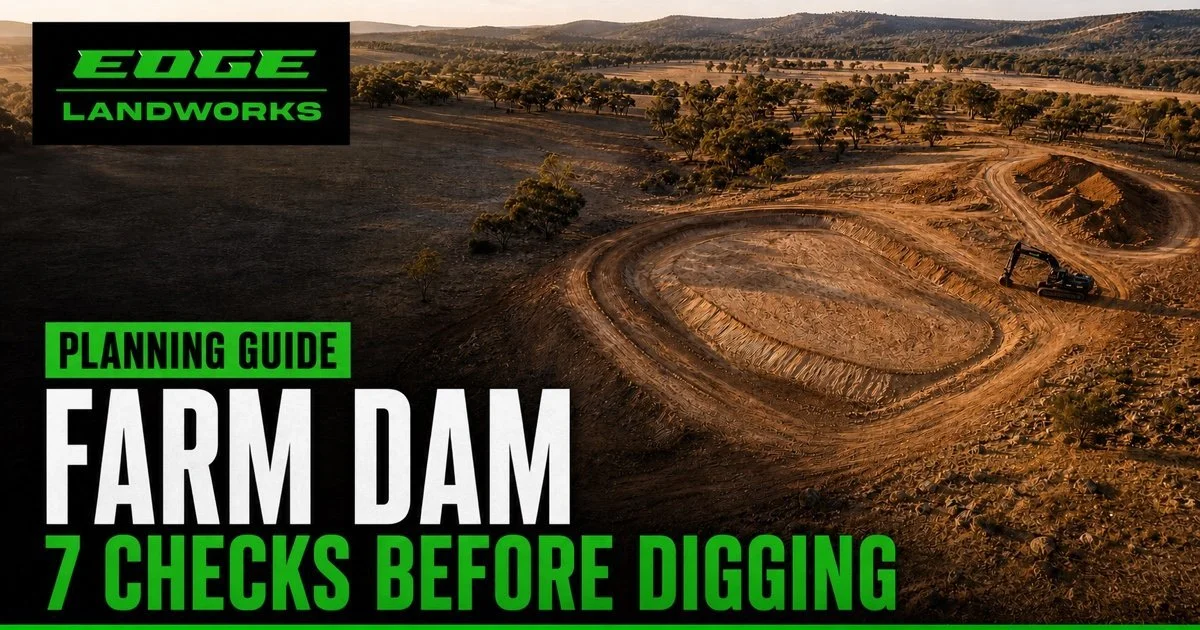
A farm dam starts with the job it needs to do. That decision affects where it can sit, how machinery reaches it, where excavated material goes and what approvals may apply.
The aim is not to pick a spot and start digging. It is to settle the important questions while changes are still easy to make.
This guide is a practical starting point for rural property owners planning dam construction or repair in Western Australia. It is general information only, not legal, environmental, engineering, hydrological, geotechnical or work health and safety advice.
1. Be clear about the dam’s purpose
Start with the intended use, not a guessed size.
A dam used for stock water may need different access and operating arrangements from one intended for irrigation, property water storage or another rural use. The intended demand also affects how the landholder assesses capacity, catchment and refill reliability.
Write down:
- what the water will be used for
- when it is needed most
- how water will enter and leave the dam
- whether vehicles, pumps or stock need access
- what maintenance access will be needed later
Edge Landworks can discuss the practical excavation, access and earthmoving scope. Hydrology, engineering and water-demand calculations should come from appropriately qualified advice where the project needs them.
2. Check the location, catchment and waterway status
A low point in a paddock is not automatically the right dam site.
Look at where runoff comes from, where overflow would travel, nearby waterways or wetlands, property boundaries and what sits downstream. A dam that intersects a watercourse raises different questions from an off-stream excavation that captures runoff within one property.
The WA Government lists conditional farm-dam exemptions from water licensing. Those exemptions depend on matters such as where water is captured, effects on a watercourse or wetland, environmental effects and consistency with local by-laws.[1]
DWER also states that a dam or weir permit is always required for an on-stream dam or weir in a proclaimed surface-water area.[2]
Water licensing and a permit to interfere with bed and banks are separate checks. A water-licensing exemption does not, by itself, remove a bed-and-banks permit requirement or another approval that applies to the site.[2]
That is why a blanket answer such as “farm dams never need approval” is unsafe. Confirm the site’s status with DWER and the relevant local government before work begins.
3. Understand the ground before setting a price
Soil and subsurface conditions affect how a dam can be excavated and whether the proposed site is practical.
Sand, gravel, rock, fill, seepage and variable clay content can change the excavation method, material handling and design response. Conditions can also vary across the same property.
Useful pre-start information may include:
- previous excavations or dams on the property
- known rock, wet ground or imported fill
- test pits or soil investigations
- survey information
- engineering or geotechnical advice where required
Do not treat a machinery quote as proof that the site will hold water or that an embankment design is suitable. Edge Landworks is being presented here as the earthworks contractor. Site investigation, hydrology, geotechnical advice and engineering need to come from the appropriately qualified people appointed to the project.
4. Confirm water, clearing and local approvals
The required approvals depend on the site and proposed works.
Questions may include:
- Is the site in a proclaimed surface-water area?
- Will the work interfere with the bed or banks of a watercourse?
- Will water be taken, diverted or discharged?
- Will native vegetation be cleared or flooded?
- Do local planning rules or by-laws apply?
- Are there approval conditions that need to be shown on the work plan?
WA Government guidance says clearing native vegetation generally requires a clearing permit unless an exemption applies or DWER has decided through the referral process that a permit is not required.[3] DWER’s Form 3P guide also notes that flooding native vegetation is considered clearing.[2]
The landholder or project proponent needs to identify and obtain the approvals that apply before machinery starts. An approval, exemption or referral decision under one law does not establish that every project requirement has been met. Applicable planning, Aboriginal heritage, Commonwealth environmental and other site-specific requirements may also need to be checked.[3][6] Edge Landworks is not being presented as obtaining, certifying or guaranteeing those approvals. It can quote and carry out the machine work once the applicable limits, conditions and project documents have been supplied.
Aboriginal heritage is a separate consideration. WA Government guidance states that landowners must not knowingly damage an Aboriginal cultural heritage site.[6] Where a known or potential site may be affected, obtain appropriate heritage information and advice before disturbing the ground. A database or map search alone does not prove that no heritage is present.
5. Plan safe machine access and service checks
A workable dam location still needs practical access.
Large earthmoving equipment needs enough room to enter, turn, work and leave without relying on assumptions made from a map. Check gates, tracks, culverts, bridges, soft ground, slopes, overhead powerlines and space for support vehicles.
Before excavation, obtain current information about underground and overhead infrastructure. WorkSafe WA’s excavation code says the exact location of certain underground services needs to be established before excavation starts.[5] Before You Dig Australia provides plans and information for proposed work sites, including private property, but those plans are a starting point rather than proof that every public or private service has been located.[4][5]
A useful access pack includes:
- clear photos or video from the road to the work area
- gate and narrow-point measurements
- known weight or height restrictions
- marked underground services and private infrastructure
- overhead-line information
- wet-weather access limits
- a safe area for loading, unloading and turning
Access can change the machinery, transport and time needed, so it should be checked before the quote is locked in.
6. Decide where spoil, overflow and water will go
Excavated material is part of the project, not an afterthought.
Agree whether material identified as suitable under the supplied design or appropriate qualified advice will form part of an embankment, be spread on the property, be stockpiled for another use or be moved elsewhere. The plan should also account for unsuitable material, topsoil and any vegetation or debris found in the footprint.
Overflow and downstream effects need the same attention. DWER’s Form 3P guide asks about bypass arrangements, water leaving the property and possible effects on neighbouring land.[2]
Project documents supplied by appropriately qualified people may need to define:
- the dam footprint and excavation limits
- embankment construction requirements
- spillway or bypass arrangements
- finished levels and freeboard
- erosion protection
- where overflow travels
- how neighbouring land and infrastructure are protected
These are design inputs, not details to improvise while digging. Where engineering or hydrology is required, have that information ready for the contractor.
7. Define the finish and future maintenance
A clear scope should say what “finished” means.
That may include trimming batters, shaping access, spreading nominated material, setting aside topsoil, erosion controls or leaving a route for future inspection and clean-out work. Fencing, stock access and pump access may also need separate planning.
Before handover, check:
- the completed contracted work is visually compared with the supplied footprint, excavation limits and project documents
- material is placed where agreed
- access and exclusion areas are clear
- overflow paths are not blocked
- temporary hazards or unresolved items are recorded
- future maintenance access remains possible
A farm dam will still need inspection and maintenance over time. The landholder should monitor erosion, sediment build-up, vegetation, access and any signs of damage, then obtain suitable advice where a problem appears.
What to send Edge Landworks for a farm-dam quote
Good information leads to a more useful conversation.
Send:
- the property location
- the intended use of the dam
- photos and video of the proposed area
- access photos and measurements
- any survey, design or soil information
- known watercourse, wetland or drainage features
- approval documents and marked clearing limits
- the intended treatment of excavated material
- details of existing damage if the job is a repair
Edge Landworks provides dam construction and repair as part of its earthworks services across Perth and South West WA. The team also handles land clearing and site preparation where that work forms part of an agreed project scope.
Common farm-dam planning questions
Do all farm dams in WA need a water licence?
No single yes or no answer covers every site. DWER publishes conditional exemptions, while on-stream dams or weirs in proclaimed surface-water areas require a permit. Confirm the proposed location and use with DWER rather than relying on a general rule.[1][2]
Can Edge Landworks obtain the approvals for me?
No. Edge Landworks can discuss access, machinery and the earthworks scope, but it is not being presented as obtaining, certifying or guaranteeing project approvals. The landholder or project proponent should identify and obtain the required water, environmental and local-government approvals and provide the approved information before work starts.
Does a dam-construction quote include design or engineering?
No. Based on Edge Landworks’ published service information, its earthworks quote covers only the excavation and related machine work stated in the written scope. Surveying, hydrology, water-demand assessment, geotechnical investigation, engineering design or certification, and approval applications or fees need to be arranged separately with the appropriate qualified advisers and authorities.
Can an existing farm dam be repaired?
Yes. Edge Landworks lists dam construction and repair as an earthworks service. The repair method depends on the condition, access, material and any design or approval requirements that apply to the proposed work.
Plan the site before booking the machine
If you are planning a new rural dam or repairing an existing one, gather the site, access and approval information before asking for a final earthworks price.
Get a Free Quote or call 0499 910 019 to discuss the practical scope with Edge Landworks.
Official information used for this guide
- [1] Water licensing exemptions | WA Government
- [2] Form 3P guide: application to interfere with bed and banks | WA Government
- [3] Native vegetation clearing permit forms | WA Government
- [4] Before You Dig | BYDA
- [5] Excavation: Code of practice | WorkSafe WA
- [6] Aboriginal Heritage Act 1972 | WA Government