Firebreak requirements across WA shires: your notice, your date
Kalamunda says 1 November. Serpentine Jarrahdale says 1 December. Firebreak notices are set shire by shire, here are the current dates across the districts we work in, and what to check before machinery is booked.
Most property owners find out their firebreak deadline from a neighbour, a mate down the road, or memory of what happened last year. The trouble is that firebreak notices are issued by each local government separately, and the dates genuinely differ. Kalamunda wants work in place by 1 November. Serpentine Jarrahdale allows until 1 December. That is a month apart, on properties barely an hour’s drive from each other.
Here is what the current notices say across the shires we work in, why the differences exist, and what to sort out on your block before machinery is booked.
Firebreak dates across the shires we service
These dates come from each council’s most recently published notice. Always confirm against your own shire’s current notice before relying on a date. They are reissued annually and requirements can change.
| Local government | Work in place by | Maintained until |
|---|---|---|
| City of Kalamunda | 1 November | 31 March |
| Shire of Mundaring | 1 November | 31 March |
| Shire of Harvey | 30 November | 15 May |
| Shire of Dardanup | 30 November | Close of the Restricted Burning Period |
| Shire of Serpentine Jarrahdale | 1 December | 31 May |
| Shire of Murray | 1 December | 15 May |
| Shire of Waroona | 1 December | 15 May |
Murray and Waroona dates are taken from their 2025/26 notices. If the following season’s notice has been issued by the time you read this, use that instead.
Why the dates are different
Firebreak notices are made under the Bush Fires Act 1954, which lets each local government set requirements for its own district. Councils set dates around local fire risk, when vegetation typically cures off, and when their brigades and rangers gear up for the season. A hills shire with heavy jarrah and steep access has a different risk profile to a coastal plain shire with cleared grazing land, so the dates and the specifications diverge.
This is also why a single “WA firebreak deadline” does not exist, and why anyone quoting you one should be treated carefully.
What a firebreak notice usually covers
The detail varies, but most notices deal with the same handful of things:
- Firebreak location: commonly inside and adjacent to the property boundary, and often around buildings, haystacks or fuel storage
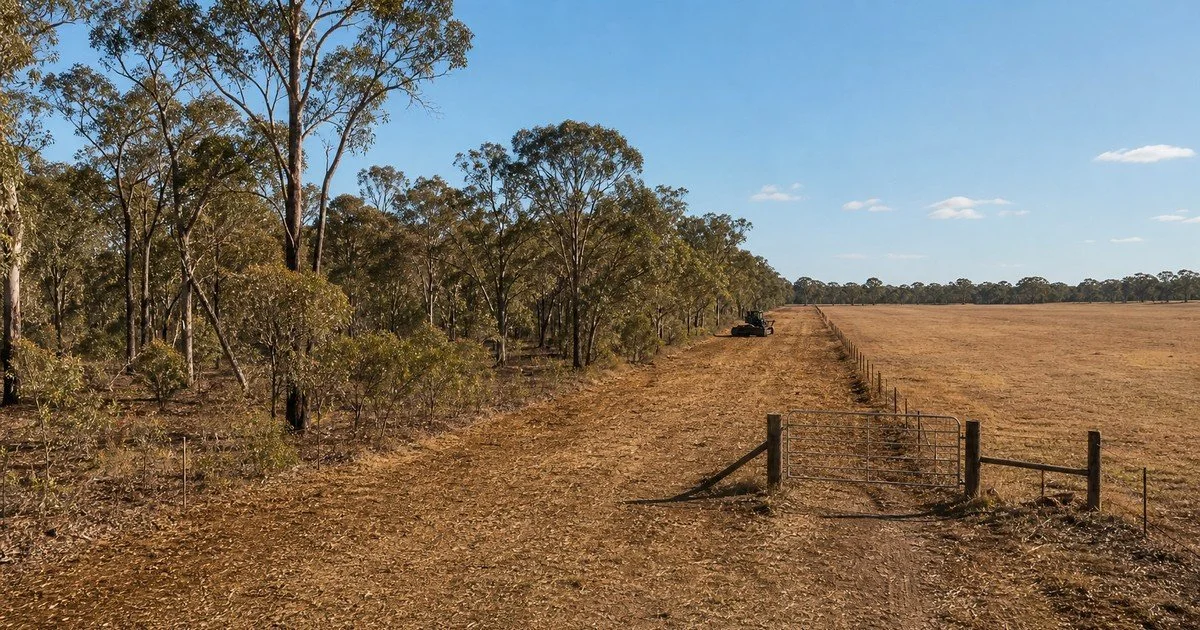
- Width and vertical clearance: a trafficable width, plus clearance above it so a brigade appliance can get through. The Shire of Waroona’s notice, for example, specifies a 3m width with 4m vertical clearance
- Fuel load across the balance of the property: many notices require grass and light fuel to be kept below a stated height, not just a break around the edge
- Access for firefighting appliances: gates, tracks and turning room
- Maintenance period: the break has to stay compliant across the whole season, not just exist on the deadline
- Penalties and variations: Waroona’s notice carries a penalty of up to $5,000, and allows a variation application if the standard requirement is impractical on your block
We install and maintain firebreaks to whatever the property’s notice requires, but we cannot tell you what your notice says. That has to come from your shire.
Why late winter is the time to book
The deadlines land between 1 November and 1 December. The work does not.
By late September the ground has dried enough for machinery to work cleanly, and that is exactly when every other property owner in the district has the same realisation. October is the pinch. Booking in August or early September means you choose the week rather than taking whatever is left, and it gives room to deal with anything unexpected: a wet crossing that needs work first, a gate too narrow for the machine, a section of the boundary nobody has looked at in three years.
It also means the break is in and settled well before the maintenance period starts, rather than being cut the week it is due.
What to check on your block before you call
- Walk the full boundary line. Note where the intended break runs and whether anything is in the way: fallen timber, regrowth, rock, old fencing.
- Check every gate. Measure the narrowest one. Machine access is the single most common reason a firebreak quote changes after a site visit.
- Look up. Overhanging limbs and powerlines affect both the vertical clearance requirement and whether the machine can pass at all.
- Find the wet spots. Anywhere still soft in late winter is worth flagging, because it changes the timing and sometimes the route.
- Note what is close to the line. Sheds, tanks, pumps, fences, septic infrastructure and neighbouring assets all shape how the work is done.
- Identify retained vegetation. If there are trees you want kept, or vegetation you suspect may be protected, say so early. Clearing native vegetation can require a permit, and that is a separate question to the firebreak notice.
What to send us for a firebreak quote
- Property address and the shire it sits in
- A copy of, or link to, your current firebreak notice
- Rough boundary length needing a break, or the property size
- Photos of the intended route, the gates, and the access track from the road
- Whether this is a new break or maintenance of an existing one
- Anything on the block that needs protecting or avoiding
- When you need it finished
Common firebreak questions
Can Edge Landworks tell me if my property is compliant?
No. Compliance is assessed by your local government, usually by a ranger or fire control officer. We carry out the work to the requirements in your notice, but confirming that a property meets the notice is the shire’s role, not ours.
Does the deadline apply if my property is vacant?
Firebreak notices generally apply to the owner or occupier of the land regardless of whether anyone lives there. Vacant blocks are frequently the ones that get missed. Check your own notice, because the wording differs by shire.
What if a firebreak is impractical on my block?
Several shires allow you to apply for a variation where the standard requirement cannot reasonably be met, because of terrain, watercourses, or protected vegetation. Waroona’s notice, for example, sets a 1 November cut-off for variation applications. Apply early; these are not usually granted retrospectively.
Can you mulch the vegetation from the break on site?
Often, yes. Eco-mulching processes cleared material back onto the ground and avoids cart-away costs. It is not right for every block, and some declared or invasive species need separate handling rather than mulching.
Do I need a permit to clear for a firebreak?
Clearing native vegetation in WA can require a permit, and a firebreak notice does not automatically override that. Where there is any doubt about the vegetation on a boundary, check before work starts rather than after.
Firebreak work across Perth and the South West
We run firebreak installation and maintenance on rural, acreage and commercial properties from the Perth Hills through Mandurah and Harvey and across the South West. Where a break needs more than a single pass due to regrowth, heavy fuel load or boundary access that has not been maintained, we handle that as part of the same job rather than sending you elsewhere.
If you are planning firebreak work for this season, get in touch or call 0499 910 019. Booking now beats booking in October.
Official information used for this guide
- City of Kalamunda, Fire Hazard Reduction Notice
- Shire of Mundaring, Firebreaks and Fuel Load Notice
- Shire of Harvey, Firebreaks
- Shire of Dardanup, Firebreaks and Fire Control
- Shire of Serpentine Jarrahdale, Firebreaks and Fire Control
- Shire of Murray, Bush Fires Act 1954 public notice
- Department of Fire and Emergency Services (DFES)
This guide is general information about how firebreak notices work in Western Australia. It is not advice on your property and does not confirm compliance. Requirements vary by local government and change between seasons. Always work from your own shire’s current notice.